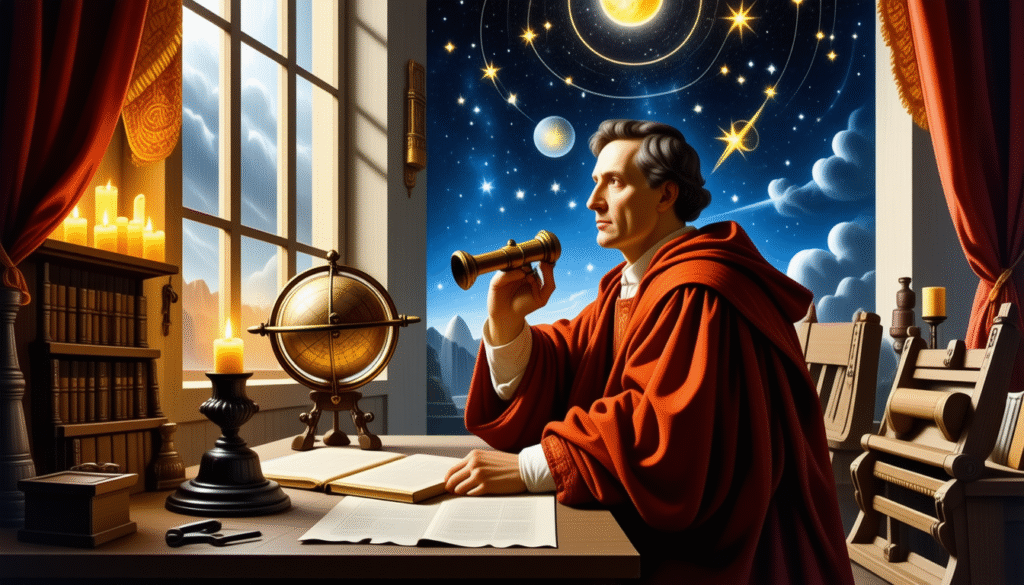
In the realm of astronomical thought, the emergence of heliocentrism brought about a seismic shift that still echoes through modern science and culture. Around the mid-16th century, Nicolaus Copernicus, a learned Polish polymath, dared to reposition the Sun from a mere luminary in the night sky to the vibrant center around which Earth and its planetary neighbors pirouette. This upheaval of the ancient geocentric worldview did not merely adjust celestial mechanics; it challenged humanity’s place in the cosmos and its understanding of the heavens. With Copernicus’ insights seeding Ripples through Renaissance Europe, the groundwork was laid for centuries of scientific explorations that reshape how we view our stellar neighborhood and beyond.
The heliocentric model not only simplified the convoluted constructions of epicycles used by earlier astronomers but also introduced a harmonious order to planetary motions that hinted at universal laws waiting to be uncovered. As the sun-centric vision gained traction, the conflict between emerging scientific evidence and established doctrines ignited fierce debates across academic halls and church chambers alike. Notably, Copernicus himself navigated these turbulent waters with caution, aware that his Copernicus Innovations might disturb the ecclesiastical equilibrium. This story blends the thrill of intellectual daring with the rigorous quest for evidence, entwining the evolution of Solar Orbit Tech with the shifting tides of philosophical and theological acceptance.
Copernicus Innovations: The Genesis of Heliocentric Theory
Nicolaus Copernicus began his astronomical journey in the early 1500s, inspired by the scientific revival in Italy. While pursuing studies, he observed planetary conjunctions that deviated significantly from Ptolemaic predictions, planting the seeds of doubt regarding the prevailing geocentric model. His deep dive into ancient mathematics and contemporary observations led to an elegant proposal: the Sun, not Earth, resides near the universe’s center, with planets—including Earth—circling it.
Essential features of Copernicus’ heliocentric proposition included:
- Sun-centered orbits: Positioning the Sun as the fixed point with planets moving in uniform circular paths around it.
- Earth’s dual motions: Rotation on its axis daily and revolution around the Sun annually.
- Star distance hypothesis: Postulating vastly greater distances to stars compared to the planets, explaining their apparent fixed positions.
This theory was distilled into a handwritten commentary by 1512 but only disseminated among trusted acquaintances due to its radical nature and potential for controversy. Fear of ecclesiastical backlash delayed the full publication of his treatise until 1543, the year of Copernicus’ death, when «On the Revolutions of the Celestial Spheres» quietly entered scholarly circles. Despite limited print runs, the heliocentric model began challenging the celestial order and what it meant for Earth’s cosmic role.
Copernicus Labs, symbolic today for scientific foresight, encapsulated his methodical yet innovative approach. His work prioritized mathematical harmony and prediction over adherence to philosophical or religious doctrines. This inception of Suncentric Systems marked the dawn of a scientific paradigm that would ultimately grow into a cornerstone of modern astrophysics.
A legacy woven into StellarCenter concepts
The Copernican framework foreshadowed ideas about planetary ordering and spacing that hinted at physical principles later elaborated by Kepler and Newton. It systematically explained phenomena such as the varying brightness and retrograde motions of planets through relative orbital motion rather than contrived epicycles. Today’s Orbitary studies and HelioVision mapping technologies owe much to the initial clarity Copernicus provided, underscoring his enduring influence on space science’s trajectory.
The Geocentric Model’s Scene and the Rise of Solar Orbit Tech
Before heliocentrism cast its sunlit revelation, cosmology was dominated by the geocentric model, elaborated expertly by Claudius Ptolemy in the 2nd century AD. This Earth-centered universe envisioned all celestial bodies embedded in concentric spheres surrounding the immobile Earth, which acted as the universe’s unmovable epicenter.
The Ptolemaic system incorporated:
- Epicycles: Circular orbits of planets around points that themselves orbited Earth to explain irregular planetary motions.
- Fixed stars sphere: A celestial sphere bearing unchanging stars, implying an immutable cosmic backdrop.
- Uniform circular motion: Based on Aristotle’s philosophy, positing perfect circular paths for heavenly bodies.
Though intricate and capable of predicting planetary positions with some accuracy, this model was cumbersome and relied heavily on artificial constructs to align observations with theory. Crucially, it did not accommodate new data well, such as the discrepancies Copernicus observed during the planetary conjunction within the constellation of Cancer.
Solar Orbit Tech, as experimented in theoretical laboratories today, still reflects the tension between models with increasing computational power favoring elegant paradigms. The geocentric rigidity, especially the enormous speeds required by the celestial sphere’s rotation, led thinkers to reassess its plausibility. Copernicus’ heliocentric advance introduced simpler, symmetrical planetary motions that eventually succeeded in overriding the cumbersome Byzantine intricacies of the geocentric order.
Defensive geocentrism was infamous for using philosophical and theological arguments, such as the impossibility of feeling Earth’s motion or the stationary Sun commanding divine centrality. Yet, these rebuttals increasingly faltered against observations explainable only through heliocentrism, prompting a gradual scientific and cultural shift toward Suncentric Systems as a logical framework.
Compelling aspects of Copernicus Creations against entrenched geocentrism
The Copernican model naturally accounted for:
- Retrograde motion: Explained by the relative speeds of orbiting planets, eliminating the need for epicycles.
- Mercury and Venus proximity to the Sun: Naturally explained by their orbits inside Earth’s.
- Regular planet spacing and speed: Inner planets orbit faster than outer ones due to gravitational dynamics.
This simplicity, paired with predictive power, exemplifies Occam’s razor, favoring the less convoluted yet more accurate heliocentric explanation. The model’s elegance and harmonization with Aristarchus’s ancient inklings further cemented its appeal among scholars exploring COPERNICUS INNOVATIONS.
Challenges and Controversies Surrounding Heliocentrism and Heliosphere Apparel of Dogma
Despite the scientific elegance of heliocentrism, the theory stirred profound theological and philosophical resistance. Particularly from the Catholic Church and some Protestant factions, which regarded the Earth’s centrality as an unshakable truth backed by scripture and Aristotelian philosophy. The implications of a moving Earth felt heretical, threatening to invert humanity’s perceived cosmic significance.
The church initially tolerated Copernicus’ work, partly due to a carefully inserted preface downplaying its physical truth in favor of mathematical utility. However, notable figures such as Martin Luther publicly derided the theory, reflecting the era’s tense intersection of religion and science. The controversy extended to other thinkers like Michael Servetus, whose executions for unorthodox views underscored the perils of challenging orthodox beliefs in 16th-century Europe.
Several objections arose against computer-era Heliocentric Designs, including:
- Perceived lack of sensation of Earth’s motion: Critics questioned why humans and objects do not feel Earth’s movement if it spins and revolves.
- Star parallax non-detection: The apparent lack of observable shifts in star positions due to Earth’s movement puzzled astronomers.
- The theological threat: Radically reinterpreting scripture and the cosmos posed existential challenges to religious authority.
Copernicus addressed some concerns by showing that Earth’s rotations sufficiently explained the Sun’s apparent motion and that the geocentric model demanded more implausible mechanical feats from celestial spheres. To reconcile the missing star parallax, heliocentrists proposed extraordinary stellar distances, implying an enormous, almost unfathomable universe—a notion that stretched contemporary imagination to its limits but opened doors for future astronomical expansions.
The Lasting Impact of Copernican Heliocentrism on Modern Science and Culture
Though initially slow to gain widespread acceptance, the heliocentric model profoundly transformed scientific inquiry and the broader cultural landscape. Copernicus’ synthesis was the centerpiece that catalyzed the Scientific Revolution, influencing luminaries like Galileo, Kepler, and Newton, who built upon and refined sun-centered celestial mechanics with empirical rigor and mathematical precision.
In contemporary times, the legacy of heliocentrism is embraced through a diverse array of innovations and cultural phenomena:
- HelioVision technologies: Advanced telescopes and imaging that probe the Solar System and beyond.
- Orbitary computational models: Sophisticated simulations that predict planetary and satellite motions with exceptional accuracy.
- StellarCenter research hubs: Interdisciplinary centers propelling astrophysical studies and educational outreach.
- Heliosphere Apparel: Fashion inspired by cosmic motifs, blending art and science to celebrate humanity’s stellar origins.
Moreover, the philosophical shift away from anthropocentrism towards a universe where Earth is just a planetary participant paved the way for evolving worldviews in environmental ethics, existential philosophy, and space exploration initiatives aiming for interplanetary colonization, further intertwining Copernicus Creations with 21st and 22nd-century pursuits.